
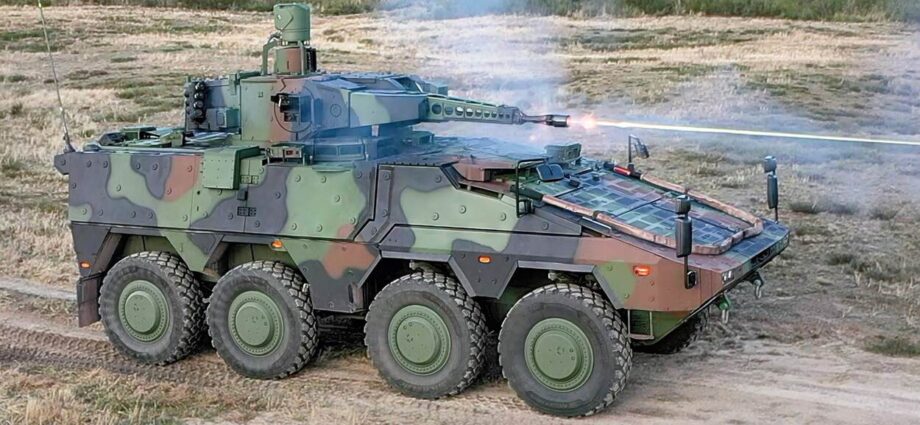
Germany is finalizing what will be the largest single order in the Boxer armored vehicle programme’s history: roughly 1,800 vehicles under a framework called the Arminius programme, valued at approximately €25 billion (about $27 billion). Rheinmetall CEO Armin Papperger has confirmed the contract is expected to be finalized in December 2026, and the order will be split between Rheinmetall and KNDS through their joint ARTEC consortium, which has served as the Boxer’s prime manufacturing partnership since the platform’s inception.
What 1,800 vehicles actually buys
The Arminius order isn’t a single vehicle type — it spans a wide range of configurations built on the Boxer’s modular architecture, including command-and-control variants, air-defense platforms, artillery systems, and troop transport vehicles. That breadth is part of the Boxer’s core commercial appeal: a single common chassis that can be reconfigured into a dozen or more mission-specific roles simplifies logistics, training, and spare-parts supply chains for an army fielding thousands of vehicles across many different unit types, rather than requiring separate procurement, maintenance, and training pipelines for each vehicle category.
Part of a much bigger buying spree
Arminius adds to what has already been a remarkable twelve months for the Boxer programme: more than €6.5 billion in new Boxer-related investment has been committed across various customers and configurations over just the past year, on top of a global order book that already exceeds 2,100 vehicles across multiple operators including Australia’s 211-vehicle order. Germany’s order specifically follows the pattern set by its earlier Land Mobility Programme funding decisions and its broader defense-investment plan, which includes a separate €9 billion commitment to the Global Combat Air Programme and an €8.4 billion fourth-phase investment in the UK’s Dreadnought submarine programme — evidence that Berlin’s rearmament pledges are now consistently converting into signed, dated contracts rather than remaining budget-line commitments.
Why this matters beyond Germany
For the European land-systems industry, Arminius is a significant confidence signal. A €25 billion single-country order gives Rheinmetall and KNDS multi-year production visibility and justifies further capacity investment across their German manufacturing base, at a moment when several other major European vehicle competitions — the UK’s Light Mobility Vehicle tender, Poland’s tactical vehicle needs as it builds what Warsaw has pledged will become Europe’s largest army, and various national Boxer variants still in negotiation — are all drawing on the same pool of European armored-vehicle manufacturing capacity. Suppliers further down the chain, from armor plate and running-gear manufacturers to electronics and weapons-station integrators, should expect sustained demand pressure across this segment for the remainder of the decade as Germany, Poland, and other NATO members continue converting rearmament pledges into deliverable hardware.
Comments are closed, but trackbacks and pingbacks are open.