
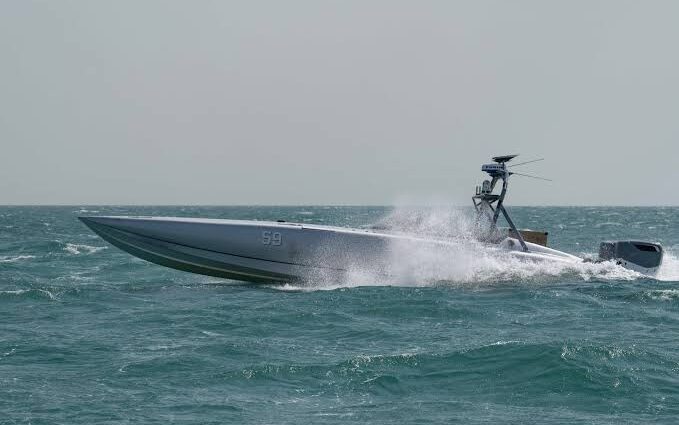
The U.S. Department of War, through the Defense Innovation Unit (DIU), has opened a prize challenge offering up to $40 million for production-ready unmanned surface vessels (USVs) armed to counter drones and helicopters, according to this week’s Pleronix Weekly Defense Overview Report. The program, formally titled Suitable Warfighting Adaptive Payloads for Unmanned Surface Vessels, is being run jointly with the Direct Reporting Portfolio Manager for Unmanned Systems, and proposals are due by November 30, 2026.
No Prototypes Need Apply
DIU has drawn a hard line on maturity: conceptual, developmental, and prototype-only designs are excluded outright. Entrants must demonstrate active production lines and documented surge capacity, and each submission must be a complete system — vessel, launcher, and effector combined. Vessel-only or effector-only entries will not be evaluated, though specialist suppliers may join as part of a teamed bid. The requirement reflects a broader shift across U.S. procurement toward buying what industry can deliver now rather than what it might develop later.
Performance and Integration Requirements
The solicitation calls for systems capable of detecting, tracking, and engaging Group 1–3 unmanned aircraft and rotary-wing threats at ranges beyond three nautical miles, with a human operator supervising engagements. Group 5 engagement capability is listed as highly desired. Platforms must achieve a minimum range of 200 nautical miles and a cruising speed of at least 10 knots, integrate with the Project Autonomous Vehicle Orchestrator, and fit within standard 20- or 40-foot ISO containers for transport aboard C-17 or C-130 aircraft. Acceptable weapon categories span Hellfire and JAGM missiles, APKWS guided rockets, remote weapon stations armed with Stinger missiles or machine guns, high-power lasers, and other mature effectors, with two-person field rearming required or strongly preferred.
An Aggressive Timeline
Selected entrants must demonstrate their systems within 30 days of down-selection, with in-water testing planned for early 2027, including a three-week government-run evaluation at Little Creek, Virginia, covering navigation under jamming and simulated or live-fire engagements. Systems are expected to be ready for forward operational fielding within 120 days — an unusually compressed timeline for a maritime weapons program, signaling how urgently the Pentagon views the drone threat to naval and littoral forces.
Why This Matters for Industry
DIU has stated it will weigh total cost-effectiveness — vessel, weapons, crew, and sustainment combined — above standalone platform performance, a signal that bidders optimizing purely for capability without controlling lifecycle cost may be at a disadvantage. The challenge is open to both U.S. and international vendors, widening the competitive field beyond the traditional defense-industrial base to commercial shipbuilders and counter-UAS specialists capable of teaming on a complete solution. For companies already producing USV hulls, remote weapon stations, or counter-drone sensor packages, the challenge represents a near-term path to a Pentagon production contract rather than a multi-year research program, with a formal down-select expected not long after the November 30 submission deadline.
Comments are closed, but trackbacks and pingbacks are open.