
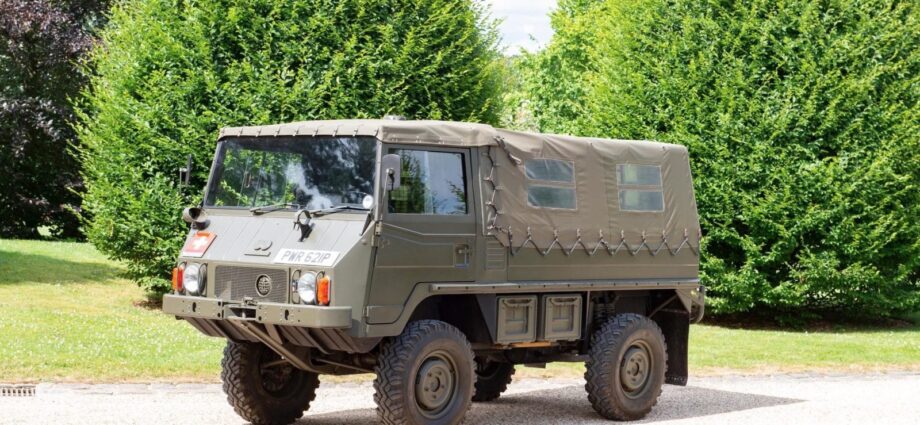
The British Army’s light utility vehicle fleet — built around the Land Rover and the Austrian-designed Pinzgauer — has been in service in one form or another since the late 1940s. That’s finally changing. The UK Ministry of Defence’s Land Mobility Programme carries a £2.2 billion budget over its first decade and aims to replace both vehicles, along with the armored Mastiff, Ridgeback, and Wolfhound families, by consolidating more than a dozen legacy vehicle types into roughly five modern platform designs.
The scale is substantial: the programme is targeting something in the range of 3,000 utility vehicles, 2,500 light platforms, 2,000 medium vehicles, and 500 heavy units across three procurement tracks — Light Mobility Vehicles (the direct Land Rover/Pinzgauer replacement, targeted for 2030), Light Protected Mobility, and Medium Protected Mobility, the last of which is aiming for initial operational capability between 2029 and 2030.
A crowded, high-stakes field
The competition for this budget is unusually crowded even by defense-procurement standards. The “LionStrike” team — BAE Systems, General Motors Defense, and NP Aerospace — has already demonstrated its proposed vehicle lineup in the UK and is pitching a major expansion of BAE’s Sheffield manufacturing facility if it wins, a detail the company has been vocal about because of the jobs attached to it. Supacat, General Dynamics UK, and Babcock International are all separately in contention, alongside two notable non-British entrants: Germany’s KNDS, pushing its Dingo platform, and Turkey’s Nurol Makina, which has already established UK manufacturing presence to strengthen its bid, plus Finland’s Patria offering a 6×6 troop carrier variant.
Why the industrial footprint matters as much as the vehicles
For companies bidding, this program is as much an industrial-policy contest as a hardware one. Analysts tracking the KNDS bid estimate a Dingo win could anchor around 1,000 direct UK manufacturing jobs and as many as 28,000 supply-chain positions spread across more than 100 manufacturers — the kind of multiplier effect that UK ministers have made a explicit condition of major defense contracts since the government’s 2023 defense-industrial strategy. Expect whichever team wins to lean heavily on domestic production commitments in their pitch, not just vehicle specifications.
For executives across the ground-vehicle sector, the Land Mobility Programme is a useful bellwether: it’s one of the largest Western army vehicle recapitalization efforts currently in competition, and how the UK balances legacy suppliers like BAE against newer entrants like KNDS and Nurol Makina will likely shape how other NATO militaries structure their own vehicle-replacement tenders over the next five years.
Comments are closed, but trackbacks and pingbacks are open.