
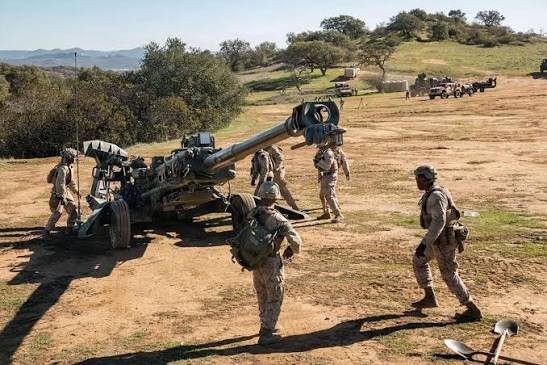
The U.S. Army is seeking new industrial partners to manufacture 155mm howitzer barrels, citing concerns that its single existing plant cannot meet the current surge in demand, according to this week’s Pleronix Weekly Defense Overview Report. The move is intended to expand the industrial base and increase production capacity for a component the Army has identified as critical to its artillery modernization and ammunition stockpile goals.
A Single Point of Failure
That single existing plant is almost certainly Watervliet Arsenal in Albany, New York, which has long served as the Army’s sole producer of cannon tubes for the M1 Abrams tank, the M109 Paladin self-propelled howitzer, and the M777 lightweight howitzer. Maj. Gen. Michael Lalor, commander of the Army’s Tank-automotive and Armaments Command, has said the arsenal is forging tubes at its fastest rate in roughly 40 years, with output approximately tripling over the past three years following the surge in demand triggered by military aid to Ukraine beginning in 2022. Despite that growth, Army leadership has acknowledged that concentrating all cannon tube production in one facility leaves the force exposed to a single point of failure.
Qualifying a Second Source
The Army has identified multiple potential secondary producers capable of standing up production lines, provided they receive the technical data packages required to manufacture the tubes to military specification. Army officials have estimated these new lines could become operational within 12 to 18 months of a decision to proceed, though they caution that cannon tube manufacturing is a specialized capability that resists further timeline compression. Separately, the Army has also published a special notice seeking commercial technologies that can modernize legacy manufacturing equipment at Watervliet and its associated Benet Laboratories, opening the qualification process to both traditional defense contractors and non-traditional suppliers of automation, tooling, and industrial infrastructure.
Part of a Broader Artillery Build-Up
The barrel-sourcing push sits alongside a wider Army effort to expand 155mm production across the board, including a separate goal of reaching 100,000 complete 155mm artillery rounds per month. That ammunition expansion has already involved multi-billion-dollar investment in metal parts production, load-assemble-pack facilities, and propellant supply, reflecting an Organic Industrial Base modernization effort with several parallel lines of action rather than a single isolated fix.
Implications for the Industrial Base
For established forgers and precision machining firms, the Army’s search for a second cannon-tube source represents a rare entry point into a highly specialized and historically closed segment of the artillery supply chain. Companies with heavy forging capacity, deep-hole gun drilling expertise, or existing relationships with the Army’s Organic Industrial Base are best positioned to compete for the technical data packages once they are released. Given the Army’s 12-to-18-month estimate for a new line to reach production, industry observers should expect formal solicitations or technology-transfer agreements to begin emerging within the coming fiscal year, though the exact mechanism and funding vehicle have not yet been detailed publicly.
Comments are closed, but trackbacks and pingbacks are open.