
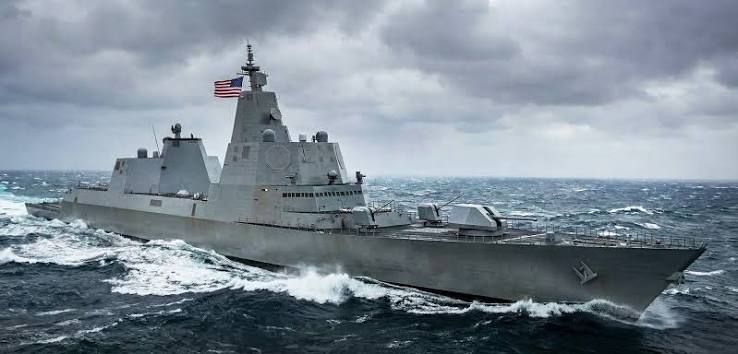
The Congressional Budget Office has put a number on the U.S. Navy’s planned fleet of next-generation nuclear-powered guided-missile battleships, and it’s a large one: approximately $275 billion for the full 15-ship program, running from 2027 through 2056. The lead ship alone would cost an estimated $23.4 billion, with subsequent vessels averaging around $18 billion per hull once the class enters serial production — a cost curve that assumes the shipyards involved can actually hit the learning-curve efficiencies CBO’s model relies on.
What the Navy is actually trying to build
The ships in question are being described as the largest surface combatants in the world, and the largest built for the U.S. Navy since the Second World War: 35,000-ton nuclear-powered vessels combining heavy missile-defense and strike capability in a single hull. HII’s Newport News Shipbuilding facility would perform final assembly in Drydock 12, with major sections built at other yards and brought together for integration — a manufacturing approach the CBO report flags explicitly as a sign that industrial-capacity constraints, not just cost, are shaping how the program is being structured from the outset.
The budget math that should worry procurement planners
The number that matters most for anyone modeling Navy shipbuilding budgets isn’t the $275 billion total — it’s what that figure does to the Navy’s annual surface combatant spending. Including the battleship program would push the Navy’s surface combatant budget from roughly $6.9 billion a year currently (fiscal year 2025 levels) to about $15.2 billion annually, more than double current spending, sustained over three decades. That’s a level of budget growth that would need to compete directly against the Navy’s existing destroyer, frigate, and submarine programs for the same limited pool of shipyard capacity, skilled labor, and appropriated dollars — a tension that shows up repeatedly across this year’s defense-budget reporting, from B-52 modernization delays and cost overruns to the broader munitions-production strain the Pentagon has been urgently pressing contractors to fix.
Why CBO is flagging so much uncertainty
CBO was unusually direct about the limits of its own estimate, noting the figures rely heavily on its own assessments of a ship design that isn’t finalized and an overall program structure still taking shape, with costs likely to shift as technology choices and the industrial plan mature. That uncertainty cuts in both directions: the $275 billion figure could prove conservative if shipyard bottlenecks force schedule extensions and cost growth, the pattern that has affected nearly every major U.S. Navy shipbuilding program of the past two decades, or it could come down if the Navy simplifies scope in response to the industrial-capacity warnings baked into this report.
What it means for the shipbuilding supply chain
For executives across naval shipbuilding and its supplier base, the CBO report is a useful early planning signal regardless of whether the battleship program proceeds exactly as currently envisioned. A doubling of annual surface combatant spending, sustained over 30 years, represents a substantial and durable demand signal for propulsion systems, combat-system integration, specialized steel and materials suppliers, and skilled shipyard labor — but only if the industrial base can actually scale to meet it. Given how directly this report ties cost outcomes to shipyard capacity rather than design alone, expect the Navy’s next budget request to include as much detail on workforce and facility investment as on the ships themselves.
Comments are closed, but trackbacks and pingbacks are open.