
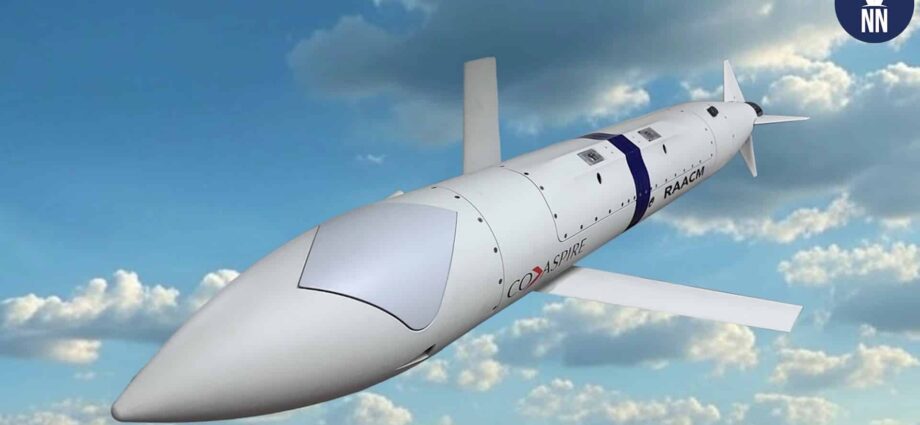
The U.S. Navy has awarded a $70 million Other Transactional Agreement to CoAspire to develop a ground-launched cruise missile under the Coalition Heterogeneous Affordable Offensive Strike program — CHAOS, in Pentagon shorthand. The missile itself, the Rapidly Adaptable Affordable Cruise Missile-Extended Range (RAACM-ER), is built around a straightforward premise: allied ground forces need a way to strike ships and land targets at long range without paying Tomahawk prices to do it.
The range and cost numbers that matter
RAACM-ER is a turbojet-powered, trapezoidal-airframe missile with GPS-assisted navigation and a long-wave infrared seeker capable of engaging moving targets, including ships. Its estimated range — roughly 485 to over 900 nautical miles depending on configuration — roughly doubles the original RAACM design and puts it well beyond the reach of the U.S. Navy’s current Harpoon (about 150 miles) and Naval Strike Missile (about 162 miles). That range puts RAACM-ER in a strategic gap between short-range anti-ship missiles and the Tomahawk, which costs $1 million to $2 million or more per unit and remains tightly controlled for export. RAACM-ER is explicitly designed not to be that expensive.
Built to be given away, not just bought
What sets CHAOS apart from a typical Navy weapons program is the intent behind it: this isn’t primarily a U.S. Navy magazine-filler, it’s a vehicle for arming coalition partners with a credible long-range strike capability the U.S. can produce and transfer quickly. CoAspire says its manufacturing approach — leaning on commercial off-the-shelf components and additive manufacturing — lets it develop new missile variants in months rather than years, and lets production scale up fast if a partner nation places a large order. That’s the same “affordable mass” logic showing up across this year’s defense-tech announcements, from Lockheed’s PAC-3 ACE interceptor to BAE’s Brontanax drone concept: cheaper, faster-to-build systems designed to be fielded in volume rather than as small batches of exquisite, expensive hardware.
For defense executives, CHAOS is worth tracking less as a single contract and more as a template. If the Navy’s bet pays off, RAACM-ER becomes a fast, exportable option for allies who need real long-range maritime strike capability but can’t access or afford Tomahawk-class systems — a market gap that’s been sitting open as tensions rise in the Indo-Pacific and the Middle East. Expect competitors, particularly in Europe’s missile sector, to respond with their own lower-cost, rapidly exportable strike-missile concepts before the year is out.
Comments are closed, but trackbacks and pingbacks are open.