
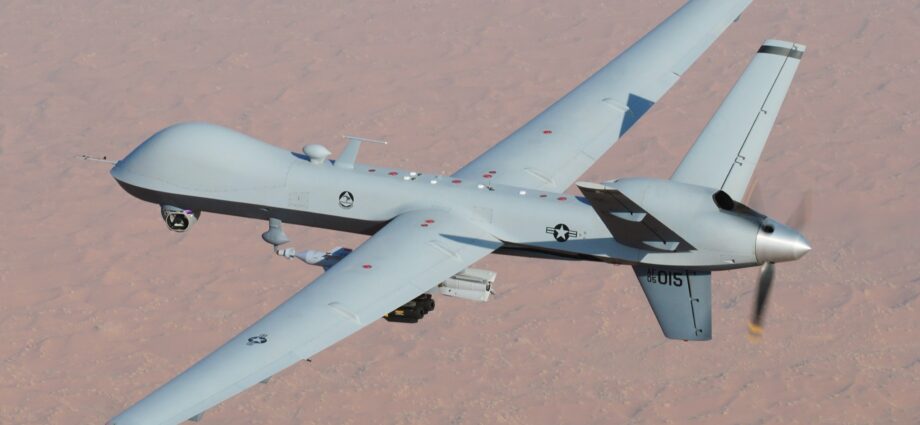
India’s Ministry of Defence has issued a Request for Information worth roughly ₹2,000 crore (about $240 million) for 10 Medium Altitude Long Endurance (MALE) drones for the Indian Coast Guard — the service’s first planned induction of this class of unmanned aircraft. Technical and commercial submissions are due by October 7, 2026.
On its own, this is a modest-sized deal. What makes it worth watching is the list of expected bidders: Adani Defence and Aerospace, Tata Advanced Systems, Solar Industries, Larsen & Toubro, and state-owned Hindustan Aeronautics Limited are all positioning to compete. That’s a lineup of India’s largest private conglomerates going head-to-head with the traditional state-owned defense giant — a competitive dynamic that’s become the norm rather than the exception in Indian defense procurement over the past three years.
What the drones are actually for
The mission set is squarely maritime: persistent surveillance across India’s Exclusive Economic Zone, which extends 200 nautical miles from shore, and support for search-and-rescue operations across a zone stretching out to 1,000 nautical miles. The drones will need satellite communications for beyond-line-of-sight operation and continuous real-time data transmission, giving the Coast Guard 24-hour persistent coverage that its current crewed Dornier 228 fleet can’t match. Priority missions include anti-smuggling and counter-narcotics patrols and protecting the Andaman and Nicobar Islands, a strategically sensitive chain near the Malacca Strait chokepoint.
The bigger number behind the headline
This tender doesn’t exist in isolation. It runs alongside a much larger ₹32,000 crore (roughly $3.8 billion) program to acquire 87 MALE drones across the Indian Air Force, Army, and Navy — meaning the Coast Guard order is really a smaller preview of where a much bigger wave of Indian defense spending is headed. Both programs sit under India’s “Make in India” and “Aatmanirbhar Bharat” (self-reliant India) policy umbrella, which increasingly requires foreign systems integrators to partner with, license to, or lose out to domestic manufacturers rather than sell finished platforms outright.
For companies watching India’s defense-industrial buildout, the signal is clear: the country’s growing appetite for MALE-class drones is being met almost entirely by homegrown industrial champions rather than direct imports, a shift that mirrors what’s happened in India’s missile and radar sectors over the past several years. Foreign drone manufacturers hoping to participate in India’s unmanned aviation boom will need to do so through joint ventures and technology-transfer partnerships with the same companies now bidding against each other for this contract — not as prime contractors in their own right.
Comments are closed, but trackbacks and pingbacks are open.