
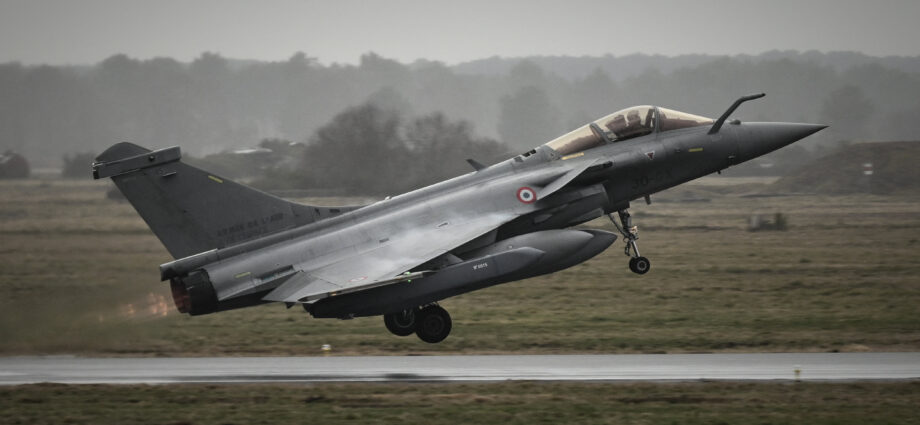
France has submitted detailed technical and commercial proposals to supply India with 114 Rafale fighter jets, in a deal valued at roughly ₹3.25 lakh crore — approximately $38.9 billion. If it closes, it would be one of the largest single fighter-jet orders placed anywhere in the world this decade, and by far the largest addition to the Indian Air Force’s combat fleet in a generation.
The structure of the offer
The proposal follows a government-to-government structure, and its most significant detail isn’t the aircraft count but how they’ll be built. Of the 114 jets, 94 would be manufactured in India under a technology-transfer arrangement, while the remaining 20 would be delivered in flyaway condition to meet the Indian Air Force’s more immediate operational needs. That split matters: India’s defense procurement policy has increasingly conditioned major foreign purchases on domestic manufacturing content, and a deal of this size with an 82% domestic-build ratio would represent one of the most substantial technology-transfer commitments any Western fighter manufacturer has made to India to date.
Why India needs this now
The Indian Air Force has been running below its sanctioned squadron strength for years, as older MiG-21 and Jaguar airframes retire faster than replacements arrive. India already operates 36 Rafales purchased in a 2016 deal, giving the type an established maintenance and training ecosystem that works in France’s favor as it competes for this larger follow-on order. A 114-jet addition would meaningfully close India’s fighter-availability gap at a moment when its air force faces two potential adversaries — China and Pakistan — both of which are modernizing their own combat fleets.
What’s at stake for Dassault and the broader French defense sector
For Dassault, a win here would be transformative. India would become the anchor customer for a second major production line, effectively extending Rafale’s manufacturing life well beyond what French orders alone could sustain, at a time when France’s next-generation fighter ambitions have grown murkier following the well-documented friction inside the Future Combat Air System program with Germany and Spain. A large Indian order also strengthens Dassault’s export pitch to other prospective Rafale customers evaluating the aircraft against competitors like the Eurofighter Typhoon, Saab’s Gripen, and Boeing’s F-15EX — proof that the platform can anchor a multi-decade industrial partnership, not just a one-time sale.
No contract has been signed, and deals of this size in India typically take years to move from proposal to signature, with price negotiations, offset commitments, and technology-transfer terms all subject to extended back-and-forth. But the scale of this proposal, and the fact that France moved to submit detailed technical and commercial terms rather than a preliminary offer, suggests both sides see a real opportunity to close a deal in a relatively compressed timeframe by regional standards. For the broader fighter-jet export market, an Indian Rafale win at this scale would be a significant signal that legacy 4.5-generation Western aircraft, offered with genuine industrial partnership terms, can still win against both emerging Asian competitors and pressure to wait for next-generation platforms still years from maturity.
Comments are closed, but trackbacks and pingbacks are open.